
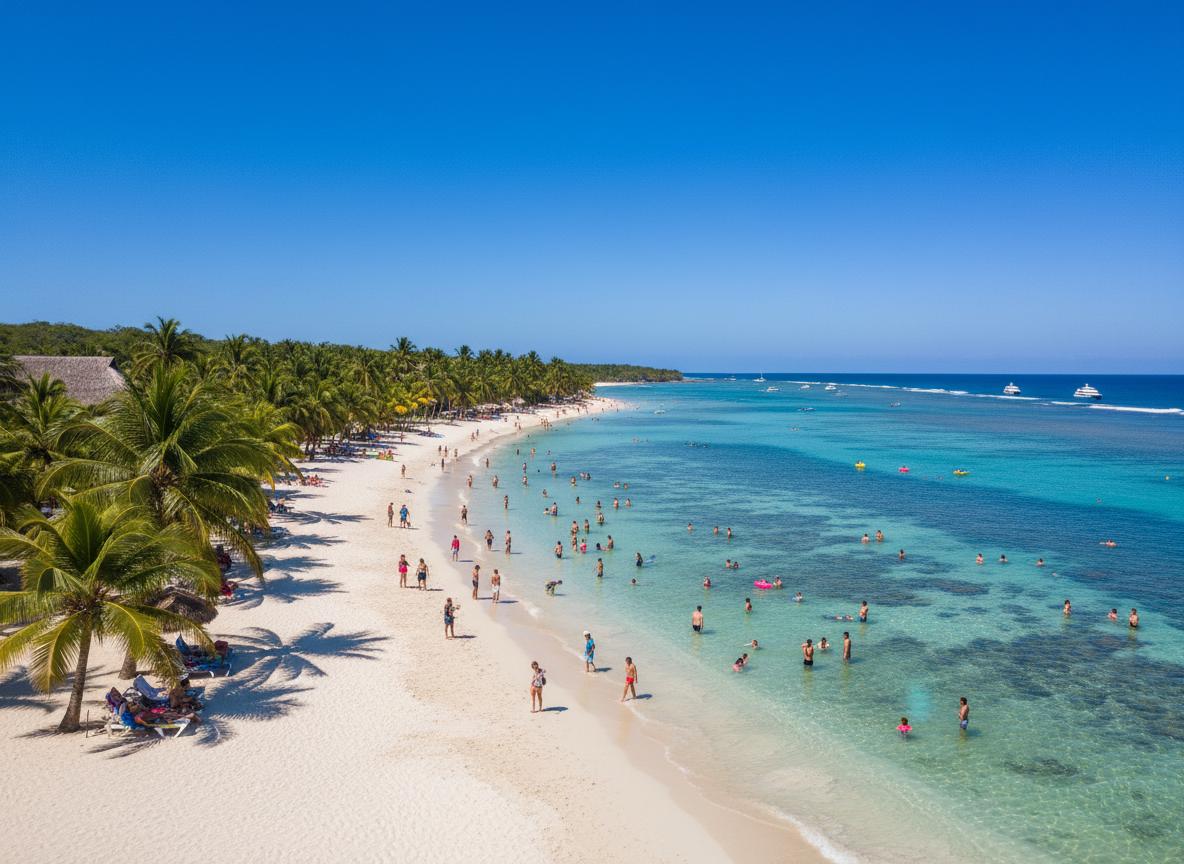
At a Glance
- Closed sales down 15.8% in deal count and 20.4% in dollar volume vs Q1 2025.
- Average days on market increased from 250 to 317 — a 27% slowdown in absorption speed.
- Buyers negotiated a median 8.3% off list price, up from 5.9% a year earlier.
- Two geopolitical events — the Iran war outbreak and the US Venezuela operation — directly suppressed North American buyer activity across the full quarter.
- Sandy Bay was the strongest non-West Bay submarket; West End closed zero deals despite new pre-construction activity.
Bay Islands Q1 2026 Market Analysis | Residential, Multi-Family & Commercial Property
If you read most Q1 2026 Roatán real estate market summaries, you'll come away thinking the market is roughly flat year-over-year. The headline numbers — total volume, average sale price, contract activity in West Bay — look stable. But that read is misleading.
A meaningful portion of the Q1 2026 contract volume came from a single broker-owned development whose sales are partly transacted directly with U.S. buyers outside the standard Roatan MLS flow. Once you adjust for that pipeline, the underlying Roatán market tells a very different story: fewer deals, longer days on market, lower offers accepted, and a buyer pool clearly hesitating against a backdrop of two major geopolitical shocks.
This report compares Roatán property performance for Q1 2025 vs Q1 2026 across residential, multi-family, and commercial transactions (land sales excluded). We focus on closed sales as the most reliable measure, while noting what under-contract activity tells us about forward demand.
Quick Answer: Is Roatán Real Estate Up or Down in Q1 2026?
Closed sales are down approximately 16% in deal count and 20% in dollar volume year-over-year. Properties are taking 27% longer to sell, and buyers are negotiating roughly 8% off list price — versus 6% a year earlier. The underlying Roatán resale market is meaningfully softer than at any point in the past three years.
The Geopolitical Backdrop: Two Shocks Hitting Q1 Buyer Sentiment
Q1 2026 was not a normal real estate quarter. Two major geopolitical events directly affected the buyer profile that drives Roatán demand — primarily U.S. and Canadian buyers, alongside Honduran nationals and longtime expat residents.
The 2026 Iran War
On 28 February 2026, Israel and the United States began a series of strikes against Iran, with the stated aim to induce regime change and target its nuclear and ballistic missile programme. A conditional ceasefire was declared on 8 April. (Source: House of Commons Library)
The economic spillover hit immediately. Global oil prices spiked 11% after Iran threatened to close the Strait of Hormuz. Around 20% of global petroleum and 20% of liquified natural gas traverses the Strait of Hormuz each year. Pre-conflict, around 3,000 vessels used the strait each month — their numbers fell to around 5% of this level. (Source: House of Commons Library)
For North American buyers — the core of Roatán's market — the war's outbreak in late February meant the entire final month of Q1 unfolded against headlines about a major Middle East conflict, a global oil shock, and potential stagflation in Europe. Discretionary capital allocations to second homes and investment property in another country are the first thing to freeze under those conditions.
The Venezuela Operation
On 3 January, the US conducted a military operation in Venezuela that removed President Nicolás Maduro and his wife, Cilia Flores, from the country.
While Roatán does not draw heavily from a Latin American buyer base, the Venezuela operation shaped Q1 2026 in two indirect ways: it created broad regional uncertainty about U.S. military posture in the Caribbean, and it dominated North American news cycles during January — a critical month for snowbird buying decisions and travel planning to the Bay Islands.
The combined effect of these two shocks bracketing the entire quarter is the single most important context for reading the Q1 2026 numbers.
Closed Sales: Q1 2026 vs Q1 2025
Covering residential, multi-family, and commercial transactions on Roatán and the Bay Islands. Land sales excluded.
| Metric | Q1 2025 | Q1 2026 | Change |
|---|---|---|---|
| Closed deals | 38 | 32 | −15.8% |
| Total volume | $15.8M | $12.6M | −20.4% |
| Average sold price | $415K | $392K | −5.5% |
| Average days on market | 250 | 317 | +26.8% |
| Median sale-to-list ratio | 94.1% | 91.7% | −2.4 pts |
What the closing data tells us
- Buyers in Q1 2026 negotiated harder. A 91.7% median sale-to-list ratio means the typical Roatán property sold for about 8.3% below asking price. In Q1 2025, buyers were conceding only 5.9% off list.
- Properties marketed two months longer. Average DOM jumped from 250 to 317 days — a 27% increase.
- The mid-market took the hit. Average closing price dropped, suggesting weaker mid-volume demand rather than weakness at the high end.
These three signals together — fewer deals, longer marketing periods, larger discounts — define a clear buyer's market.
What About Under-Contract Activity?
Headline under-contract volume looks flat year-over-year, but this metric is unusually noisy in Q1 2026 and we'd encourage caution interpreting it. Roatan MLS contract dates reflect when listings are recorded as under contract — not necessarily when the buyer-seller agreement was actually reached. Some Q1 2026 contracts represent reservations that had been pending for months and were finally entered into the system this quarter. Others represent transactions handled outside the typical MLS flow that only surface when paperwork catches up.
What we can say with confidence: the closing data — which reflects executed transactions with fixed dates — shows a clear cooling market. Deal counts are down, marketing periods are stretched, and sellers are conceding more. That picture aligns with what we hear on the ground from active brokers across West Bay, West End, and Sandy Bay.
Best Performing Areas in Q1 2026
Top Areas by Closed Sales (Q1 2026)
- West Bay (WB) — 8 deals, $3.0M
- Sandy Bay (SB) — 5 deals, $1.5M
- Utila (UTI) — 4 deals, $1.5M
- Coxen Hole / Turtle Crossing — 2 deals each
Geographic Highlights
- Sandy Bay was the standout submarket of Q1 2026. Five closed sales totaling $1.5M, with strong activity in the under-$400K range. For buyers priced out of West Bay, Sandy Bay offered the best balance of activity and value.
- West Bay remains the leader by deal count but at lower average price points than Q1 2025, reflecting a shift toward smaller, lower-priced units closing while higher-end inventory sits.
- West End cooled. Despite new pre-construction launches, Q1 2026 closing activity in West End slipped from 4 deals to 0 — surprising given West End's normally consistent demand.
- Camp Bay broke through at the high end with two large transactions in Q1 2026, the kind of pocket activity that lifts averages without reflecting broad market health.
What This Means for Buyers and Sellers
For buyers
The Roatán market in Q1 2026 is the most buyer-friendly it has been in three years. Median sale-to-list ratios under 92%, average DOM over 300 days, and a 16% drop in deal count mean sellers are increasingly motivated. Aged inventory — listings over 6 months on market — is the primary leverage point. The geopolitical noise that has cooled other buyers is your opportunity. Sellers who decided to list in 2025 are watching new activity drop and are more negotiable than the headline averages suggest.
For sellers
Pricing right at listing time matters more than ever. The market is rewarding price discipline, not aspirational asking prices. Properties relying on long marketing periods to find a buyer are facing a smaller, more cautious buyer pool than a year ago. If you're listing in Q2 2026, expect a longer absorption window and price accordingly from day one.
For investors
The closing data reflects buyer caution far more than property fundamentals. Roatán's underlying demand drivers — North American retirees, Canadian snowbirds, Honduran capital seeking safe Caribbean assets — are intact. Q1 2026 weakness is a function of timing (Iran war, Venezuela operation, oil shock) rather than structural decline. Investors who can act when others are hesitating typically find their best entry points in quarters that look exactly like this one.
Reading April Through the Right Lens: Closed = Lagging, Under Contract = Leading
The April closings (−65% YoY, −73.5% by volume) look catastrophic in isolation. But that is not what they actually tell us about today's market.
Closed sales in April 2026 reflect deals negotiated during the worst weeks of Q1 — late February (Iran war outbreak) through March (oil shock, Hormuz closure, peak Venezuela headlines). The 30–60 day lag between contract and close means April closings are essentially a delayed snapshot of peak geopolitical uncertainty. They were always going to print weak.
Under-contract activity in April 2026, by contrast, reflects buyer decisions made in April itself — after the Iran ceasefire was announced (April 8) and as North American buyers began processing the new equilibrium.
Reframing the April data side-by-side:
| Indicator | April 2025 | April 2026 | Direction | What it tells us |
|---|---|---|---|---|
| Closed deals | 20 | 7 (−65%) | Lagging | How bad Q1 actually was |
| Closed volume | $7.06M | $1.87M (−73.5%) | Lagging | Buyer commitments during the shock |
| Properties under contract | 16 | 10 (−37.5%) | Leading | Softer, but not collapsed |
| Under-contract volume | $4.51M | $5.06M (+12.2%) | Leading | Higher YoY despite fewer deals |
| Median DOM at contract | 273 days | 81 days | Leading | Quality listings moving fast |
The volume signal matters
This is the data point that changes the narrative: April 2026 under-contract volume was actually 12% higher than April 2025 — $5.06M vs $4.51M — even with 38% fewer deals. The buyers who returned to the market in April were not bargain-hunting at the bottom of the price spectrum. They were committing to higher-priced, higher-quality product at near-asking prices.
When closed-sale volume drops 73% but pending volume rises 12% in the same month, you're not looking at a deteriorating market. You're looking at a market where the lag and lead indicators are pulling in opposite directions — and the lead indicator is what predicts May and June.
The single-development question — does it matter for April?
Earlier in this analysis we flagged a single broker-owned beachfront development as the biggest distortion in Q1 contract activity. For April, the picture is much cleaner.
| Metric | Including that development | Excluding it |
|---|---|---|
| Contracts | 10 | 8 |
| Volume | $5.06M | $3.49M |
| YoY volume change | +12.2% | −22.6% |
That single development accounts for 2 of the 10 April contracts and $1.57M of the $5.06M volume (31%). Stripping it out, the rest of the Roatán market saw 8 contracts at $3.49M — roughly half the deal count of April 2025 (16 contracts at $4.51M).
The recovery signal still holds without that development, just less dramatically. Even excluding it:
- 8 fresh contracts in a single month is meaningful activity for a recovering market.
- The median DOM at contract for those 8 was still well below the 273-day April 2025 figure — well-priced listings across the broader market are also moving fast.
- 3 of the 8 contracts were in Utila, totaling $0.96M — confirming the geographic shift away from West Bay into emerging submarkets flagged in the Q1 analysis.
In short: the single beachfront development helped, but it did not manufacture the April recovery signal on its own.
What this combination actually signals
A market that took a hard hit in Q1 and is now stabilizing — not deteriorating further.
- Lagging indicator (closings) shows how bad Q1 was.
- Leading indicator (April under-contract) shows demand returned in April, with volume actually up YoY and serious buyers committing to quality product fast.
- The recovery signal is real with or without the broker-owned beachfront development — that one project amplifies the signal but doesn't create it.
The investment implication shifts
Earlier in this analysis we framed Q1 as the most buyer-friendly market in three years. The April under-contract data refines that view.
The buyer-leverage window may be narrower than it appears. Aged inventory will remain negotiable for several more months as those sellers absorb the Q1 reality. But fresh, well-priced listings are already moving in 81 days at near-asking prices, with rising dollar volume committed. That's not a market in free-fall — that's a market where the opportunistic window is closing on the best product even as it stays open on aged stock.
For buyers
Move on aged inventory now. New listings priced correctly will not stay negotiable.
For sellers
If you list in May or June, price for today's market — not Q1 2025 comps. Properties priced correctly are selling in under 3 months. Aspirationally priced listings will join the aged-inventory pile and sit.
For the market overall
April's leading-indicator data is the first sign that the Q1 shock is being absorbed, not extended. May and June closing data — reflecting these April contracts — should print materially better than April closings did. If that happens, the cooling thesis becomes a quarter-long disruption rather than a structural shift.
Methodology
Data sourced from the Roatán Bay Islands MLS for January 1–March 31, 2025 (Q1 2025) and January 1–March 31, 2026 (Q1 2026). All figures cover residential, multi-family, and commercial transactions only — land sales are excluded. "Closed" means transactions with a recorded closing date in the quarter. Under-contract data was reviewed but is noted as having reliability limitations due to the timing of MLS contract entries relative to actual agreement dates.
Frequently Asked Questions
Did Roatán property values go up or down in Q1 2026?
Average closed prices fell 5.5% year-over-year (from $415K to $392K), and the median sale-to-list ratio dropped from 94.1% to 91.7%, indicating buyers negotiated larger discounts off asking prices. This reflects buyer caution amid global geopolitical events more than a structural decline in underlying values.
How did the Iran war and Venezuela crisis affect Roatán real estate in Q1 2026?
The US military operation in Venezuela on January 3 and the outbreak of the Iran war on February 28 bracketed the entire quarter with major geopolitical uncertainty. The Iran war's oil shock and global market volatility froze discretionary capital decisions for North American buyers — Roatán's primary buyer base — during the closing month of the quarter. The Venezuela operation dominated US and Canadian news cycles in January, slowing snowbird buying decisions during a normally active period.
Which Roatán area had the strongest market in Q1 2026?
West Bay led in absolute deal count, with Sandy Bay close behind and showing strong relative performance. Sandy Bay was the strongest non-West Bay submarket on a dollar-volume basis.
How long are Roatán properties taking to sell in 2026?
The average closed sale in Q1 2026 spent 317 days on market, up from 250 days in Q1 2025 — a 27% increase that reflects a meaningfully slower pace of market absorption.
Is now a good time to buy property in Roatán?
Q1 2026 data shows the most buyer leverage in three years: longer marketing periods, lower sale-to-list ratios, and a 16% drop in deal count. Sellers of aged inventory are increasingly negotiable. The geopolitical uncertainty that has cooled other buyers is itself the opportunity for investors willing to act when others are hesitating.
Who buys real estate on Roatán?
The Roatán buyer base is overwhelmingly North American — primarily US and Canadian buyers — alongside longtime expat residents and Honduran nationals. Unlike some Caribbean destinations, Roatán does not draw heavily from Latin American buyer flows, which is why the Venezuela crisis affected sentiment more than transaction flow directly.
Data analysis based on MLS records for Q1 2025 and Q1 2026 covering residential, multi-family, and commercial transactions on Roatán and the Bay Islands. Market conditions are subject to change. This report is for informational purposes only and does not constitute investment advice.